Glory Outside of Time
- Jan 29, 2025
- 9 min read
I am about to propose an idea - multiple ideas tied into a singular premise which we as Christians agree, but taking it a step further. The first proposed idea is not mine, it has been brought up by others in the past, but I shall present it in my own way now. I do not wish to try and convince you of a new idea in the faith, but rather propose something interesting, a thought exercise, that may be absolutely true, or could just be an interesting thought experiment.
Now, first, the premise. That is, that God is outside of time. Simple enough concept, right? The one who created time is outside of it and unaffected by it, except for when He chose to descend into the world in the form of man in which He took along with that adoption of form the constraints of time. He is only "constrained" by time so long as He chooses to allow it to be imposed upon Him.
Onto the first point of this story I wish to spin for you. I would like to first visit the passage in Exodus where God walks before Moses on Mount Sinai. At the end of chapter 33 we hear the Lord talk about how He will descend onto the mountain and that Moses will be able to look at His back but not His face. In 34 this descent of the Lord happens, and God walks before Moses.
In ancient days, and to a degree it remains the case to this day, people would climb mountains to get nearer to God. The nearer you are to the Heavens, the nearer you are to God. And so, Moses climbs the mountain to get near God, and returns to this mountain when he needs to speak to God again.
Next, we have the story of Elijah. In 1 Kings 19:11 the Lord tells Elijah to go up upon Mount Horeb where He will pass before Elijah. If are familiar with the story then you'll recall that there was a great hurricane, an earthquake, and a fire, but God was not in any of these three things. But then came a still small voice, and at this Elijah came out of the cave in which he was residing and covered his face, because the Lord was in that still small voice. It doesn't say "the glory of God" was in the still small voice, it says simply that God was in it, and Elijah was about to present Himself before the very God of creation so he humbles himself by covering his face. Elijah covers his face, as Moses removed the sandals from his feet when he encountered the burning bush, for the same reason Moses bows down when on the mount - because we are in a holy place as we enter the presence of the Lord and we are unworthy so we must humble ourselves before Him to be in His presence.
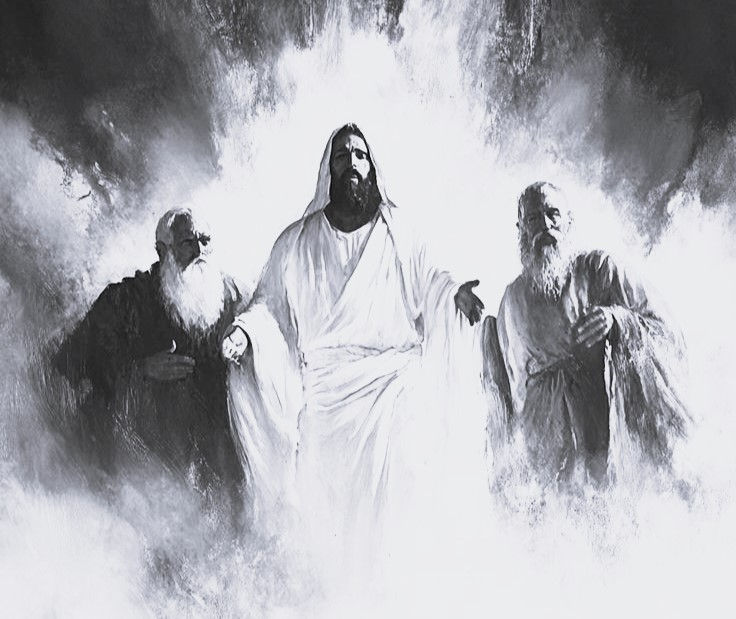
Now, a third story, to begin the end of this first part that I am proposing to you. In Matthew 17 Christ climbs what scholars believe to be Mount Tabor or Mount Horeb with the disciples Peter, James, and John. It is at this point in Scripture that the Transfiguration takes place, and Christ has from Him a blinding light radiating outwards, then He is joined by Moses and Elijah.
Here is where I want to draw your attention. The two men that appear before the Lord are the only two men in the Old Testament who climb a mountain and get to be in the presence of God. Note that in Exodus 34:5 it says that the Lord "stood with [Moses] there" on the mountain, and His glory passed by, so there was some sort of physical presence of God on the mountain; and then, Elijah while on his mountain "the Lord passed by" and it was not simply God's glory, but Him. These two men communed with God on the mountains, and God the Son revealed His glory on the mountain before three of His disciples. This idea is not my own, I did not come up with it, but I present it to you now - what if at this moment God transcended time, ripping it open and acted out these past histories in Scripture at that very moment? Perhaps the Lord was doing more than just revealing His glory to His Disciples, perhaps at that moment in Scripture Christ was reaching through the veil of time to act out in that moment the stories mentioned in Exodus and 2 Kings.
Must you believe in this idea? Definitely not. Can you reject this proposition wholesale without consequence? Absolutely. This first proposition of transcending time will not have theological consequences if ignored, but rather I believe it has the possibility of adding more depth for those who read about the Transfiguration of Christ. Isn't it curious that the two men God stands with in His glory before His disciples are the only two men in Scripture that meet God on a mountain? Perhaps it is nothing. But, could it be something? It is at the very least an interesting idea. In the presence of Peter, James, and John we read about miracles like the raising of the young girl from the dead, an instance where Christ told the three to not say anything about the miracle until after His resurrection; these three men were made witnesses to Christ's most exciting miracles, and of course the Transfiguration is an amazing miracle without the theory I'm proposing, but I still wish to propose the idea for you to contemplate.
Building off of the idea of transgressing time, I want to look at a well-known passage in Daniel. We're looking at chapter 5, where we find the King Belshazzar of Babylon lounging and drinking at a party, then a hand appears and begins writing on the wall. The king became fearful, as did all those with him at his party, and he called for his sorcerers and fortune tellers to come explain to him what had happened.
Now, before we get to the words written on the wall, I want to first explain why the king deserved to be afraid. In verse 2 Belshazzar has the holy vessels from the Jewish Temple brought out that they may be given to guests to drink from, and in verse 4 we see that while they drank from these gold and silver vessels they praised their pagan gods. In this moment the king desecrated the Temple, and so the presence of God entered into the space to deliver a message and strike fear into the hearts of those disrespecting the Temple of God.
Next, we return to the king seeking interpretation. The men he called in could not read the writing or discern the meaning of the words on the wall could mean. The king despaired, then the prophet Daniel was called to read the writing and interpret the meaning, and Daniel delivered. The writing said MENE, MENE, THECEL, PHARES. I could write explaining this, but I will let Jerome instead speak on it since he will do so more eloquently than I.
The inscription of these three words on the wall simply meant: "Mane, Thecel, Phares"; the first of which sounds forth the idea of "number," and the second "a weighing out," and the third "removal." And so there was a need not only for reading the inscription but also for interpreting what had been read, in order that it might be understood what these words were announcing. That is to say, that God had numbered his kingdom and brought it to an end, and that He had seized hold upon him to weigh him in His judgment-scales, and the sword would slay him before he should meet a natural death; and that his empire would be divided among the Medes and Persians.
To repeat it again, Mene means "number", Thecel means "weighed out", and Peres means "removal". You may have heard this Scripture written as "you have been weighed, you have been measured, and you have been found wanting" which means the same thing, but is that judgement has been passed on you and your time is coming to an end. And this was true, for after Daniel communicated this meaning the king retired for the night and was killed before the dawn. God keeps His promises.
I find enjoyment in finding different connections in Scripture and expounding upon them. Whether the connection is very strong or not, I believe it makes for an interesting conversation. And so, the next connection, and the last one for this article, is with John chapter 8, where we find the woman caught in adultery. Something I wish to point out before diving into the passage is that in Deuteronomy 22 we see the laws to be followed by the Jews regarding adultery, which entails that both the man and the woman committing adultery should be killed, not just the woman, so something is already awry in what the Pharisees are doing.
So, the Pharisees bring forth this woman and try to test Christ in this moment, seeing if He will somehow try to absolve her contrary to the laws they hold to. Rather than answering them, Christ begins to write on the ground. The Pharisees badgered Him for an answer, Christ straightened Himself, then told the one without sin to cast the first stone. And then verse 8,
And again he stooped down, and wrote on the ground.
This is where the fun begins. We have no accounts of what Christ was writing in the dirt. It could be that He was just doodling, bored with another absurd challenge by the Pharisees, which is a reasonable assumption and seems to be a majority of what is spoken of as the explanation. I wish to propose another theory: Mene, Thecel, Phares. I propose two versions of this explanation, with the first being my favorite and most bold assumption; the first explanation is that, like the Transfiguration, as Christ was pressing into the dirt He was also pressing into time and at that moment wrote the message for the Babylonian king as well as for those waiting to see what His response would be (more on that in a moment); the second explanation is like the first, an approach different than Him just doodling, and perhaps He did write Mene, Tecel, Phares, but He did not transcend time at that instance and instead simply wished to communicate something by writing these words into the dirt.
Here is my thought: King Belshazzar was weighed, measured, and found wanting and was so condemned since he desecrated the temple. Take 1 Corinthians 9:16 into your mind right now, where it says "your body is a temple of the Holy Spirit", and then recall John chapter 8 again - the woman has also desecrated the temple of God when she desecrated her body by fornicating. Mene, Tecel, but no Phares. Christ looked at her and judged her, she was weighed and measured, but the balancing scales of justice used by God abdicated her of the punishment she was due. She was weighed, she was measured, she was not found wanting.
Now, take my private and personal theory on this scene, Christ writes in the dirt and writes on the wall of the blasphemous king in the same moment, but where the blasphemous king found condemnation - if you will read the passage in Daniel you find no repentance, he only rewards Daniel for his interpretation - the adulterous woman instead finds mercy. Christ, after the others had left her when He told those without sin to cast the first stone, asked where her accusers were and said "Neither do I condemn you. Go, and sin no more." She was not found wanting.
Must you believe this interpretation of Scripture I've proposed? Of course not. But I find the understanding of this story beautiful, where one was condemned and another was redeemed.
In sharing this idea of what took place in these Scriptures I do not wish to convince everyone that this is absolutely true. All I wish is to give something for you to think about, a possible theory for what took place in Scripture. Perhaps this idea will be disproven one day, and I will be okay with that. But, what I do wish, is that you entertain this perspective, this idea of God not only bringing about justice outside of time as we see Him do throughout Scripture - as He is unbound by time - but also when He binds Himself into time when He adopts the human form He still does His work outside of what we would consider "normal time" which constantly flows forward. His justice can be exercised whenever He sees fit, and so it is with His mercy
Perhaps when Christ wrote words into the dirt He meant the Mene, Thecel, Phares to be for the Pharisees rather than the woman, or perhaps He was just doodling. Perhaps during the Transfiguration on the mount He was simply having a conversation with the two holy men, and He was opening Heaven up rather than traversing through time. Perhaps the more fantastical explanations I have put forth are true, perhaps not, but I choose to entertain these fantastical explanations so long as they do not contradict what we know to be true.
Written for VME Catholic, by Ethan Hall


Comments